

Quick Summary: Can a business replace WSIB with private insurance?
WSIB coverage is not mandatory for every business in Ontario. Where the Workplace Safety and Insurance Act, 1997 does not require your industry to be covered, an occupational accident plan can replace the provincial plan for injuries that happen on the job: weekly accident indemnity for lost income, paramedical expense reimbursement, accidental death and dismemberment, and permanent and total disability, on a schedule you set rather than one the government sets. It is accident-only, so it does not cover occupational disease, and it carries no return-to-work service.
Most owners we talk to assume WSIB is just a fact of doing business in Ontario. It is, for a lot of industries. But not all of them, and the businesses that fall outside mandatory coverage are rarely told that they have a choice at all.
If you are in one of those occupational classes, you have three options. Register with the WSIB anyway and buy into the plan on everyone else’s terms. Go without coverage for your people and carry the exposure yourself. Or replace it with occupational accident insurance, which is accident-only disability coverage built to do the job the provincial plan does for a workplace injury, with a benefit schedule you set instead of one the government sets.
This is what that third option actually is, who is allowed to use it, and where it falls short. We would rather you understood the gaps before you asked us for a number.
Key takeaways
- WSIB coverage is not mandatory for every business in Ontario. The government lists the industries and types of employees that must be covered in the Workplace Safety and Insurance Act, 1997. Outside those lists, coverage is a choice.
- Owners are not covered automatically. Registering covers your employees. Sole proprietors, partners, independent operators and executive officers need a separate, optional request for themselves.
- Construction is the exception. Expanded compulsory coverage means construction cannot exempt itself.
- The 2026 average premium rate is $1.23 per $100 of insurable payroll, but class rates run from $0.18 to $3.55. Your class rate, not the average, is what you pay.
- An occupational accident plan pays a schedule you set: weekly accident indemnity, accidental paramedical expense, accidental death and dismemberment, and permanent and total disability.
- It is accident-only. No occupational disease, no return-to-work service, and no statutory liability shield.
Can a business replace WSIB with private insurance?
Yes, where the Workplace Safety and Insurance Act, 1997 does not require the business to be covered. Ontario does not impose WSIB on every industry or every type of worker, so a business outside mandatory coverage can replace the provincial plan with private accident coverage that responds to injuries on the job. Where coverage is compulsory, most obviously in construction, it cannot.
That is the whole legal answer. The rest of this article is about whether it is a good idea for your business.
Who can opt out of WSIB?
Three groups can be outside mandatory WSIB coverage. They are not interchangeable, so it is worth being precise.
1. Industries the Act does not require to be covered. The Government of Ontario decides which industries and which types of employees must have WSIB coverage, and lists them in the Workplace Safety and Insurance Act, 1997. If your industry is not on that list, you have no obligation to register. In the WSIB’s own words: “WSIB coverage isn’t mandatory for every business in Ontario.”
2. Independent operators. The WSIB rules an owner/operator either an employee (a worker) or an independent operator. If you are ruled an independent operator, the business that hired you is not responsible for premiums on your earnings, and, per the WSIB, that “also means that the owner/operator is not covered for any workplace injuries.” You can then apply for optional insurance for yourself, or arrange coverage privately. Incorporating does not settle the question: “Just incorporating your company does not make you an independent operator.”
3. Owners of businesses that are not required to register. Sole proprietors, partners, independent operators and executive officers. Even where a business does register, ownership is separate: “Your premiums cover your employees, but not owners (except for most construction businesses).” Owner coverage is a separate, optional request.
Who cannot opt out: construction. Independent operators, sole proprietors, some partners and some executive officers who work in construction must have WSIB coverage and must register. Construction is out. If that is you, the rest of this article is not your decision to make, and anyone telling you otherwise is worth a second look.
What does WSIB actually pay?
Before comparing prices, it helps to see the whole benefit list you are stepping away from. On an allowed claim, the WSIB can provide:
- Loss-of-earnings benefits when you miss time from work
- Non-economic loss benefits where the injury causes a permanent impairment
- Health care: treatment, medical devices, equipment and supplies, and prescription drugs
- Help returning to work, including a customized return-to-work plan
- Loss-of-retirement income: 5% of the benefit set aside into a retirement fund, paid from age 65, for people under 64 who have received loss-of-earnings benefits for at least a year
- Specialized services for seriously injured people and for people with occupational diseases
- Survivor benefits for spouses and dependants of someone who died from a workplace injury or illness
Three features of that list are easy to miss and hard to replace.
Occupational disease. Long-latency conditions such as cancers, noise-induced hearing loss and occupational asthma are covered by the WSIB. An accident policy does not cover illness, full stop.
The return-to-work machinery. The WSIB builds a return-to-work plan and has a formal process behind it. A private plan pays a benefit and leaves the return-to-work work to you.
Adjudication posture. The WSIB decides claims inside a statutory framework with its own appeal structure. An insurer decides claims against contract wording. Those are different processes and they do not always produce the same answer on the same injury.
There is also a liability question that people usually discover late: being inside the workers’ compensation system is part of why an injured worker cannot sue the employer for a workplace injury. An employer operating outside the system should confirm their civil liability exposure with their own lawyer and their commercial general liability insurer before making the change. We can tell you what an accident plan pays. We cannot tell you what your liability position looks like, because that is a legal question and it belongs on the checklist.
What does WSIB cost in 2026?
The WSIB formula is simple arithmetic:
2026 at a glance
The 2026 average is the lowest it has been in more than 50 years. The average is not your rate. Your rate is set in two steps: a class rate based on the shared risk of every business doing the same kind of work, then a risk band that adjusts for your own experience, meaning insurable earnings, claims costs and allowed claim counts over a six-year period. Risk bands sit roughly 5% apart.
Selected 2026 class rates
The spread between classes is where the conversation usually starts. Dollars per $100 of insurable earnings:
What that looks like on real payroll
- $250,000 of insurable payroll at $1.23 means $3,075 a year
- The same payroll at $2.10 means $5,250 a year
- $1,000,000 of insurable payroll at $2.10 means $21,000 a year
- $1,000,000 at $3.41 means $34,100 a year
The class rate tells you what the WSIB thinks your risk costs. It does not tell you whether you are eligible to leave, because that depends on the industry lists in the Act, not on the rate. It does explain why owners in the middle and top of that table start asking the question.
What does occupational accident insurance cover?
Occupational accident coverage is an accident-only product. It is built from four blocks, and the plan you buy is a schedule of how much of each:
Accidental death and dismemberment. A lump sum if a covered accident causes loss of life, limbs, speech, hearing or sight.
Weekly accident indemnity. A weekly cash benefit that replaces lost income while someone is totally or partially disabled by a covered accident. This is the block that stands in for the loss-of-earnings benefit, and its size, waiting period and duration are set when the plan is written.
Accidental paramedical expense reimbursement. Help with costs the provincial health plan does not pick up, such as ambulance, semi-private hospital accommodation, mobility aids, private duty nursing, prescription drugs and paramedical services.
Permanent and total disability. A lump sum if a covered accident leaves someone permanently and totally disabled and unable to perform daily living activities.
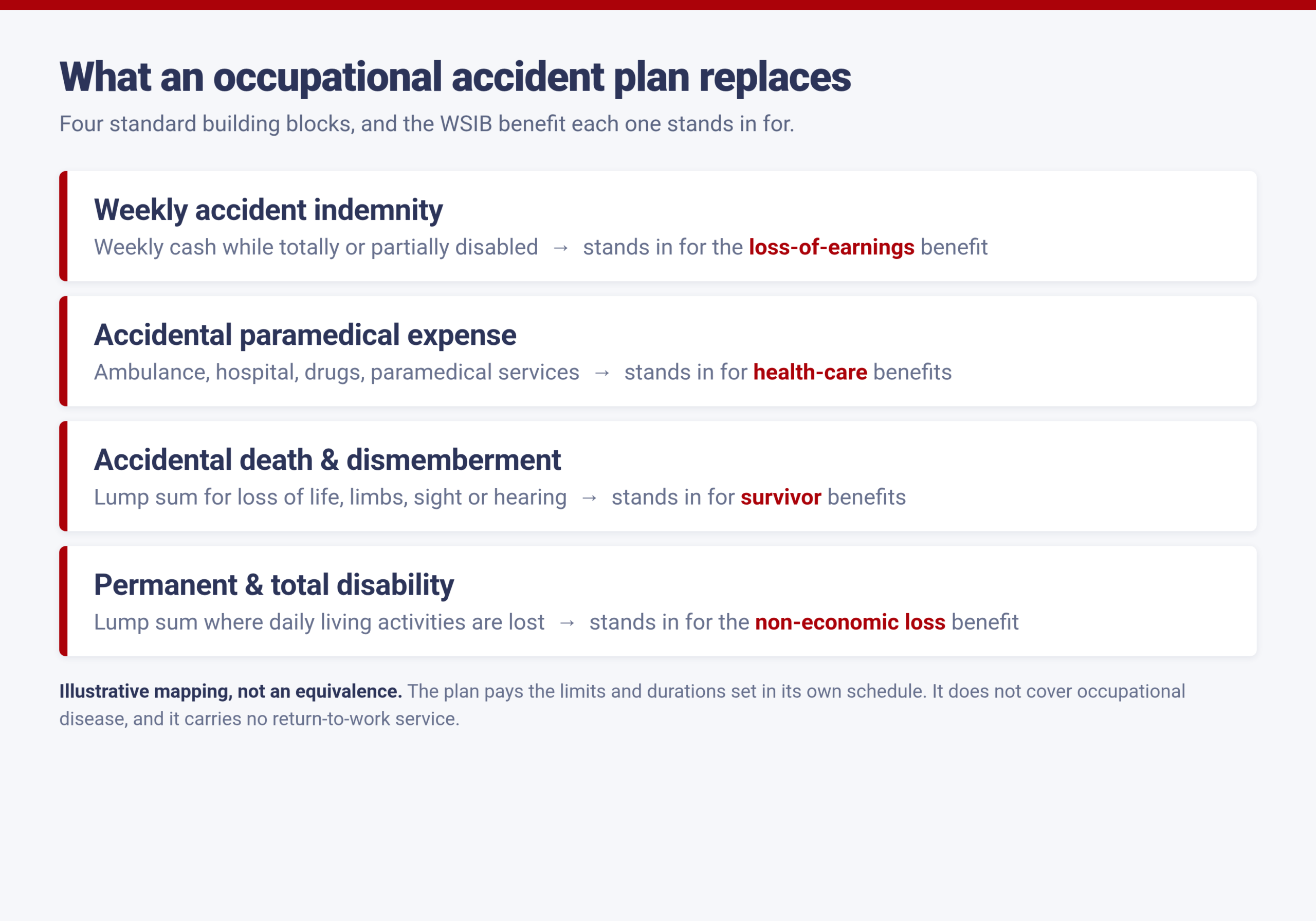
Illustrative mapping, not an equivalence. The plan pays the limits and durations set in its own schedule.
That is the core. From there the schedule is adjustable: how much weekly indemnity, after how long, for how many weeks; what capital sum sits behind the death and dismemberment benefit; what the paramedical limit is per person; how each occupation class is treated. A plan covering an owner-operator doing site supervision and a plan covering a crew doing physical work in the same company can carry different schedules and different rates.
Underneath the numbers, the same distinction recurs. With the WSIB the schedule is fixed, and the WSIB is explicit that “coverage is the same for every business registered with us, whether you’re required to have coverage or choose to have it.” An accident plan is the opposite: it is designed to your payroll, your occupational classes and your tolerance for risk.
How do the two compare?
Two rows in that table deserve more than a table cell.
The tax point is real and it is easy to get wrong. WSIB loss-of-earnings benefits are reported to the Canada Revenue Agency on a T5007 and no income tax is paid on them. A private weekly indemnity is generally taxable when the employer pays the premium. That means a weekly benefit that looks equivalent on paper can land smaller in the bank. A properly built comparison works in after-tax dollars, and a plan can be structured to close the gap.
Cost is not the same question as value. An accident plan and a WSIB assessment are not two prices for the same thing. One buys a fixed statutory benefit package with occupational disease, return-to-work and a liability shield attached. The other buys a defined schedule of accident benefits that you can size, cap and renew. If the schedule you need is large enough, the plan can be priced against a narrower set of risks than the WSIB assessment is, which is why it is worth modelling both on your own payroll rather than comparing headlines.
When does it make sense?
It tends to fit businesses where
- The industry is outside mandatory coverage, or the decision concerns owners specifically
- Payroll and class rate together make the assessment a material annual cost
- The real exposure is traumatic accident, not occupational disease
- The owner or principal is the main person to protect
- There is an appetite to choose the benefit levels rather than accept a fixed schedule
It tends not to fit where
- The business is in construction, where coverage is compulsory
- There is meaningful occupational disease exposure: silica dust, asbestos, solvents, noise, respirable hazards generally
- The workforce values a formal return-to-work process
- Payroll is small enough that the fixed administrative cost of any funded plan dominates the comparison
- Principals require a WSIB clearance certificate, which catches people more often than any other item on this list
Before you switch, check five things
- 1. Whether the Act actually exempts your industry, or whether you are relying on a rumour
- 2. Whether an independent operator status ruling is needed, and who holds the obligation to insure whom
- 3. What your current class rate and risk band actually are, from your rate statement
- 4. Whether your main contractors demand a WSIB clearance certificate
- 5. What your liability exposure looks like now that you are outside the statutory no-fault system
On that last item: a clearance certificate is the document a registered business shows to prove it is registered and up to date, valid for up to 90 days, and many general contractors will not release a subcontract without one. The WSIB notes that independent operators outside construction “might not be obligated to register with the WSIB, and therefore would not be eligible for a clearance certificate.” If your contracts depend on producing clearances, leaving the system can cost you work, and no insurance policy fixes that.
How would we run the comparison?
We are a brokerage, not an insurer, and this is not a product we can quote from a table. What we do is put both numbers in front of you on your own payroll.
To model it we need:
- Legal name and structure of the business
- Confirmation that your industry is outside mandatory WSIB coverage, or that the question is about owners only
- A plain description of the work each occupation class actually performs day to day
- How many people to insure, split between owners and employees
- Annual earnings or payroll per person
- Any claims history for the last three years
- A view on the benefit schedule: desired weekly indemnity, waiting period and duration, and the death and dismemberment capital sum
From that we can show the WSIB assessment your class and rate band would generate, the accident plan schedule priced against your occupation classes, and the after-tax shape of each. Sometimes the answer is that staying with the WSIB is the right call for your business, and we will say so.
A note on how this gets arranged. Ownership coverage and independent operator status are WSIB rulings, not insurance decisions. If the status question is open, the questionnaire comes first, because it determines who is even responsible for insuring whom. On the insurance side, an occupational accident plan is arranged as group coverage for the business, with the schedule set out in the policy wording, and coverage is subject to underwriting and the terms of the contract as issued.
Questions we get asked
Is it legal to leave the WSIB?
Where the Act does not require your industry to be covered, yes. Where it does, construction above all, no. The distinction is statutory, not a matter of preference.
Does it cover illness or occupational disease?
No. It is accident-only, and that is the single largest difference from the provincial plan. Conditions such as occupational cancer, hearing loss and occupational asthma sit outside an accident policy.
What if my contractor is ruled a worker rather than an independent operator?
Then the hiring business is responsible for their WSIB coverage, and may owe retroactive premiums. That is why a status ruling before the work starts matters more than any policy.
Can I cover the owner and the employees under one plan?
Usually yes. The schedule can include owners and employees with different occupational classifications and different amounts.
What happens if I go back to the WSIB later?
You can apply, and coverage begins when the WSIB receives your signed application. Timing matters, because a gap is a gap: nothing pays for an injury that happens while you are in neither system.
Can I have both?
You can hold accident coverage alongside a WSIB account, but you should not expect to be paid twice for the same lost income. If you are already registered, review what you hold before adding anything.
Does this replace group disability insurance?
Not exactly. A group disability plan typically responds to illness as well as accident, and pays a percentage of income after an elimination period (see our disability quotes). An occupational accident plan covers accidents that happen on the job, and pays a schedule you define. For a business outside mandatory WSIB, the second is the piece that stands in for workers’ compensation.
Talk to us about your own numbers
If your occupational class is allowed to exempt itself and the WSIB assessment has become a line item you want to reconsider, we will run the comparison on your actual payroll and tell you what we find.
Request a WSIB Replacement Disability Insurance Quote
Answer the WSIB questions below, including your current WSIB status, how many people you want to insure and what your assessment costs today, and we can price the replacement comparison on your own numbers.
Prefer to talk it through first? Call 1.866.230.5565, or see our group benefits quote and contact pages.
Red Helm Canada is a licensed Life and Accident & Sickness insurance brokerage in Ontario and British Columbia. This article is general information about how workers’ compensation and occupational accident coverage work. It is not legal, tax or insurance advice, and it is not a recommendation of any product for any particular reader. WSIB figures are as published by the WSIB for 2026 and can change; confirm current figures with the agency before relying on them. Coverage is subject to underwriting and to the policy wording as issued.
Sources: WSIB: 2026 premium rates · WSIB: Can I choose to have WSIB insurance? · WSIB: Independent operators · WSIB: Mandatory coverage in the construction industry · WSIB: WSIB benefits · WSIB: How to calculate your premium and insurable earnings · WSIB: Understanding your rate · WSIB: Clearances